How to Choose the Right Roll Grooving Machine for Your Pipe Size and Job Site
- Share
- publisher
- RUBR
- Issue Time
- Jun 10,2026
Summary
Choosing the right roll grooving machine depends on more than the maximum pipe size. Pipe diameter, wall thickness, material type, job site conditions, production volume, and application all affect the final selection. This article explains how to choose a suitable roll grooving machine for different projects, from small and medium-size pipe installation to large-diameter pipe grooving, workshop prefabrication, pipe fitting grooving, and high-accuracy groove cutting applications.
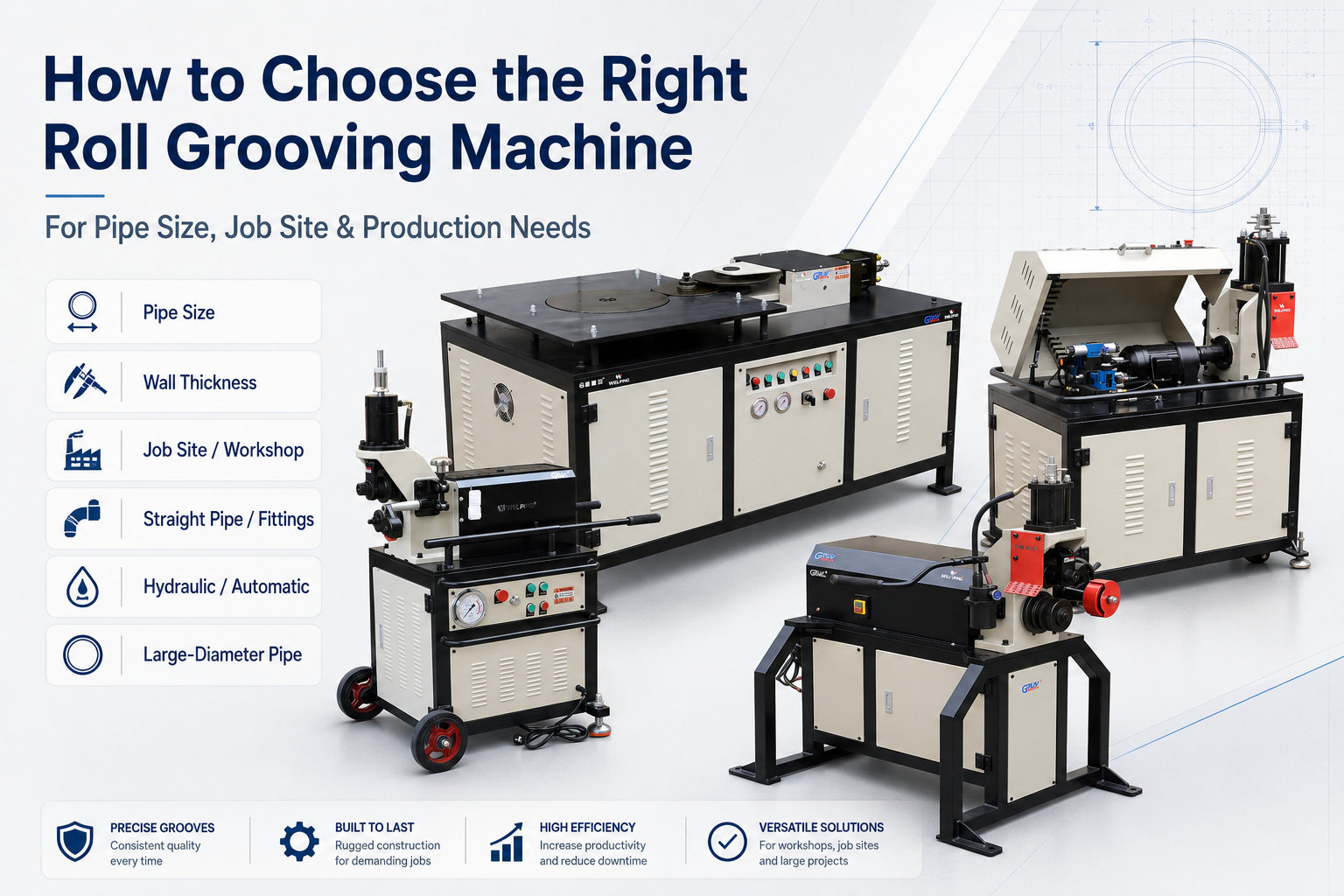
In fire protection, HVAC, municipal piping, and industrial pipe installation, roll grooving is a common but important process. A stable groove profile, proper sealing surface, and controlled pipe end condition all play a role in the final connection quality.
When choosing a roll grooving machine, many buyers first look at the maximum pipe size. That is important, but it is not the only thing to consider. A suitable machine should match the actual pipe size range, wall thickness, job site conditions, production volume, and pipe material. For different contractors, prefabrication workshops, and industrial projects, the right choice can be very different.
Gruvmaster offers multiple pipe grooving solutions covering hydraulic roll grooving machines, automatic roll grooving machines, pipe fitting roll grooving machines, groove end reforming machines, and groove cutting machines for different applications.
Start with the Pipe Size Range
For regular pipe grooving from 1" to 8" or 2" to 8", users usually care more about portability, simple operation, and easy movement on site. These machines are often used for fire protection piping, maintenance jobs, small construction sites, and flexible field work. In this range, a compact structure and easy maintenance may be more practical than simply choosing a larger machine.
For projects that often involve 1" to 12" or 2" to 12" steel pipes, versatility becomes more important. This size range is widely used in fire protection, HVAC, municipal piping, and workshop prefabrication. The machine needs to handle different pipe sizes while maintaining stable groove quality. Roller configuration, hydraulic performance, and ease of operation all affect daily working efficiency.
When the pipe size reaches 16", 24", or even 32", the selection standard becomes much higher. Large-diameter pipes are heavier, harder to support, and create more force during rotation and grooving. At this stage, the machine is not only required to “make the groove.” It also needs a stronger frame, reliable pipe support, durable rollers, and a stable hydraulic system to keep the groove consistent during heavy-duty operation.
Consider Where the Machine Will Be Used
A machine used mainly on job sites should be flexible and practical. Space may be limited, pipe sizes may change frequently, and the machine may need to be moved from one working area to another. For this kind of work, users often prefer machines with a compact design, simple controls, easy maintenance, and suitable pipe support accessories.
For workshop prefabrication or batch production, the focus is different. A prefabrication workshop usually needs higher output, more consistent groove quality, and less manual effort. Automatic feeding, groove depth control, and repeatable operation become much more important. In this case, an automatic roll grooving machine is often a better choice for improving production efficiency and keeping every groove more consistent.
In simple terms, job site work values flexibility. Workshop production values speed and consistency. Before choosing a machine, it is better to understand where the machine will be used most often.
Straight Pipes and Pipe Fittings Need Different Solutions
Most roll grooving machines are designed for straight pipe grooving. However, some projects also require grooving on elbows, tees, flanges, or other pipe fittings. These parts have different shapes and are more difficult to position and clamp with a standard straight-pipe grooving machine.
For manufacturers or workshops that handle a large number of pipe fittings, a dedicated pipe fitting roll grooving machine is the better solution. It can provide more stable positioning and use suitable tooling for different fitting shapes. This is especially useful for fitting manufacturers, prefabrication workshops, and projects with higher requirements for connection quality.
Wall Thickness and Pipe Material Also Matter
Pipe size is only one part of the selection process. Wall thickness and material type are also important.
Thin-wall pipes are more likely to deform during grooving, so they require better groove depth control and suitable roller design. Galvanized or coated pipes need a process that reduces surface damage as much as possible. For thick-wall pipes, high-strength steel pipes, or certain industrial piping systems, standard roll grooving may not always be the best solution. In some cases, groove cutting can provide better accuracy while reducing pipe deformation.
Before selecting a machine, users should confirm the pipe material, wall thickness, and project standard. These details help determine the right machine model and roller configuration.
Efficiency Decides Whether Automation Is Needed
For regular installation work or medium-volume jobs, a hydraulic roll grooving machine is often enough. It is widely applicable, practical, and suitable for many job site and workshop conditions.
For prefabrication shops, pipe processing centers, or long-term batch production, an automatic roll grooving machine can be more suitable. Automation is not only about saving labor. More importantly, it helps improve consistency. When feeding, positioning, and groove depth control are more stable, the final groove quality is easier to maintain across large quantities of pipes.
For customers who process many pipes every day, choosing an automatic machine is often an investment in long-term productivity.
A Simple Selection Guide
For 1" to 8" or 2" to 8" field grooving, a compact hydraulic roll grooving machine is usually a practical choice.
For 1" to 12" or 2" to 12" general pipe processing, a more versatile hydraulic roll grooving machine is suitable for fire protection, HVAC, municipal piping, and common prefabrication work.
For 2" to 16", 8" to 24", or 8" to 32" large-diameter pipes, users should pay more attention to machine strength, pipe support, roller durability, and grooving stability.
For workshop prefabrication and batch production, an automatic roll grooving machine can improve efficiency and consistency.
For elbows, tees, flanges, and other fittings, a dedicated pipe fitting roll grooving machine is recommended.
For thick-wall pipes, high-strength materials, or projects requiring higher groove accuracy, a groove cutting solution may be worth considering.
The Right Machine Should Match the Real Job
The best roll grooving machine is not always the largest one. It is the one that best matches the actual working conditions.
Pipe size range, wall thickness, pipe material, job site environment, production volume, and fitting type all affect the final choice. By understanding these factors clearly, customers can avoid overbuying, underbuying, or choosing a machine that does not fit their daily work.
Gruvmaster provides roll grooving solutions for small to large-diameter pipes, field installation, workshop prefabrication, straight pipes, and pipe fittings. Whether the project is a standard fire protection system or a heavy-duty industrial piping job, Gruvmaster can help customers find a practical machine configuration for their real application.