OGS vs. AGS Grooves: A Side-by-Side Comparison from Our Recent Grooving Test
- Share
- publisher
- RUBR
- Issue Time
- Jul 27,2026
Summary
OGS and AGS are two different grooved piping connection systems designed for different applications. Through a real grooving test, this article compares the differences between OGS and AGS groove profiles, explains why AGS is preferred for large-diameter piping, and shows how compatible roll grooving machines can switch between different groove systems by using dedicated roller sets.
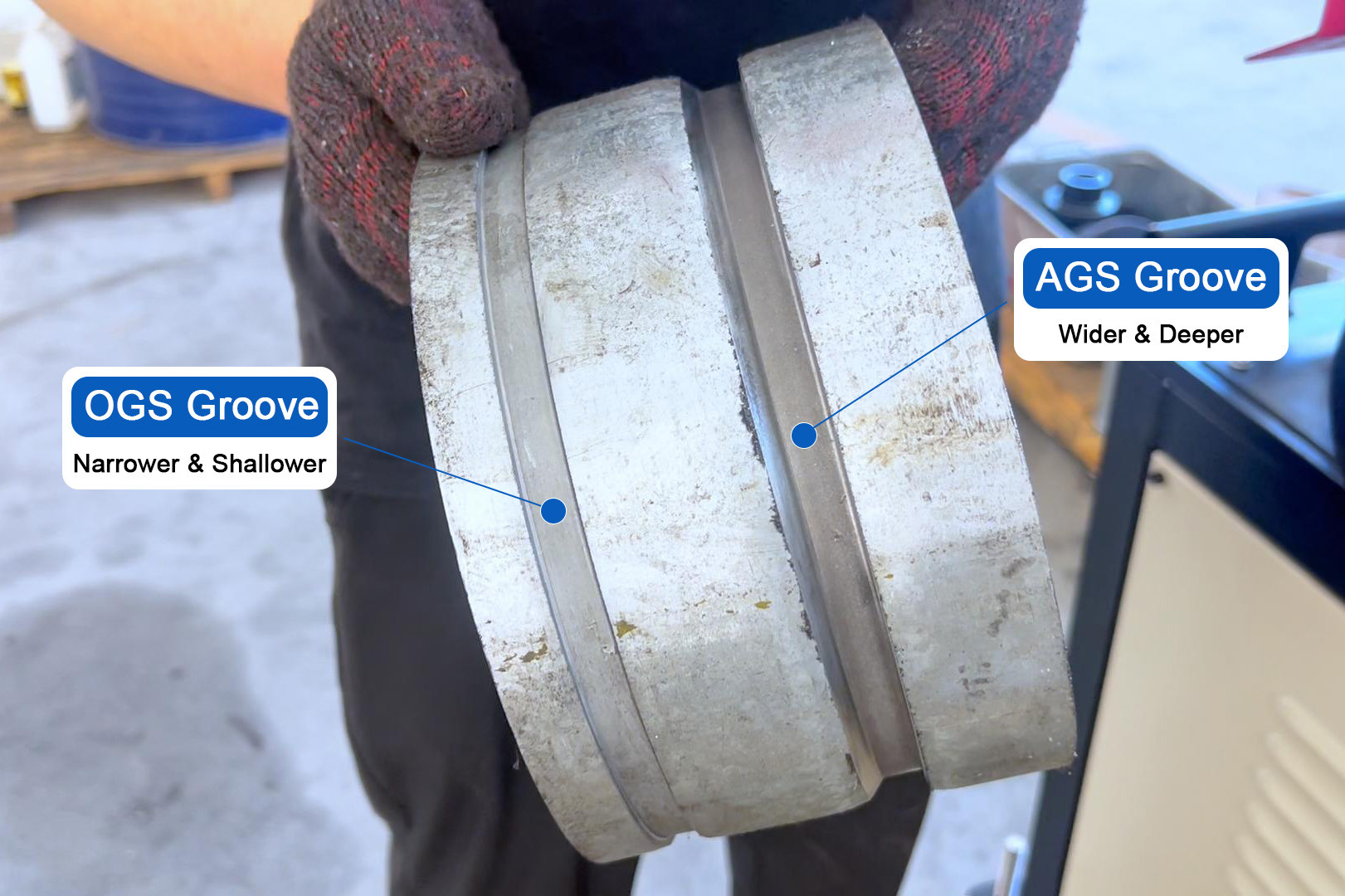
In a recent in-house test, we used two different roller sets to produce two groove profiles on large-diameter steel pipes — one with an OGS groove and the other with an AGS groove.
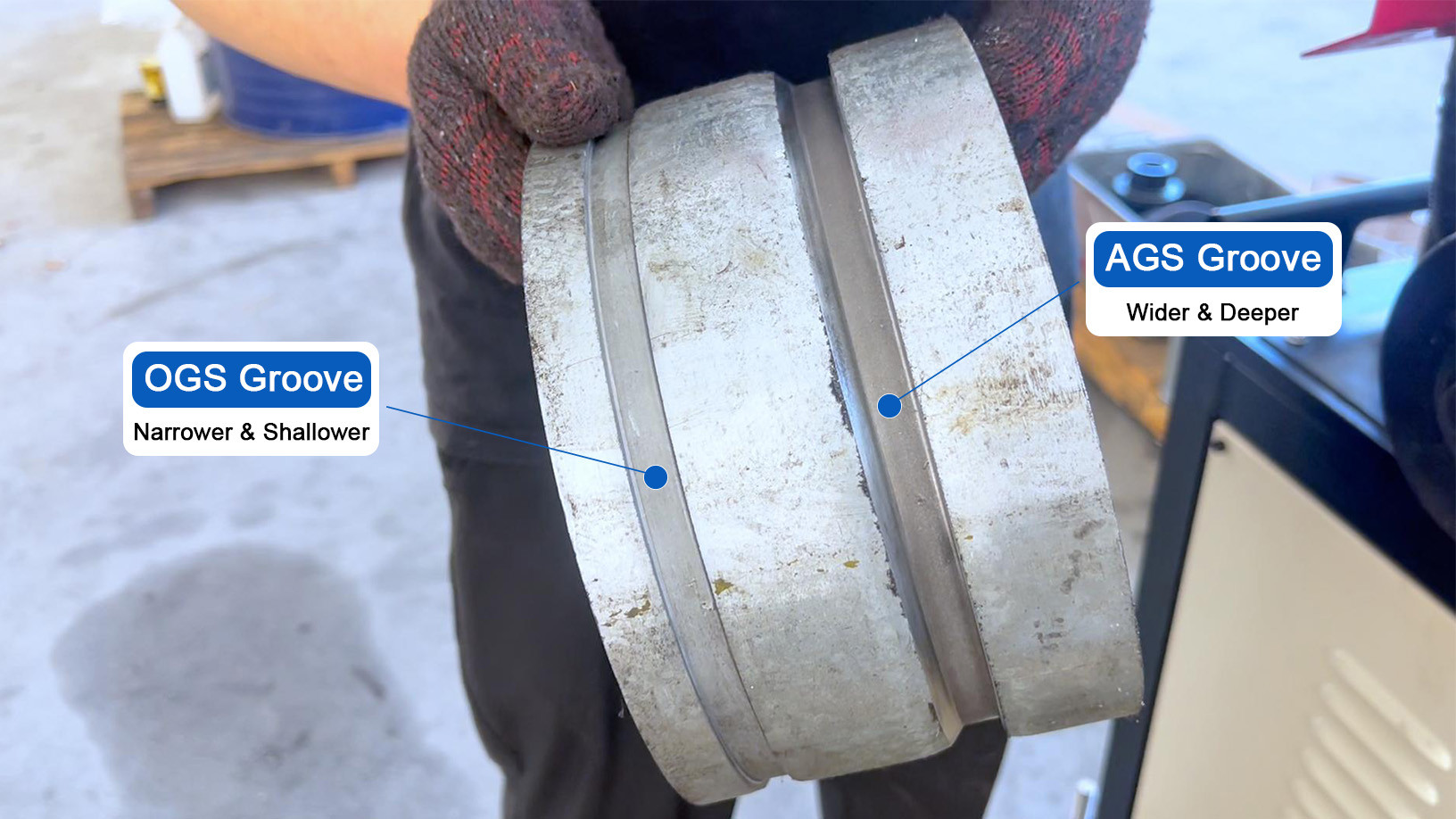
When placed side by side, the difference between the two groove profiles becomes immediately visible. One groove appears narrower, while the other features a wider and deeper profile with a different groove contour.
However, the difference between OGS and AGS is not simply about making a groove wider or deeper. They represent two different grooved piping connection systems, each designed for specific applications and requiring matching rollers, grooves, and couplings.
A Groove Is More Than Just a Recess on the Pipe
In a mechanical grooved piping connection, the pipe groove works together with the gasket and coupling to form a secure connection.
The gasket provides sealing, while the coupling keys engage with the pipe groove to prevent the pipe ends from separating under pressure. Therefore, groove dimensions — including width, depth, diameter, and profile — directly affect the performance and reliability of the connection.
A groove should be considered as a mechanical interface between the pipe and coupling, rather than simply a machined indentation on the pipe surface.
What Is OGS?
OGS stands for Original Groove System and represents one of the most widely used conventional grooving profiles in the industry.
Most standard roll grooving machines used for fire protection, HVAC, plumbing, and general industrial piping applications are equipped with roller sets designed for conventional groove profiles.
OGS grooves feature a relatively narrower profile and are commonly used with standard grooved couplings for everyday piping applications.
It is worth noting that OGS is a terminology used within Victaulic’s groove system. In general industry communication, similar profiles may also be described as standard grooves or conventional groove profiles.
What Is AGS?
AGS stands for Advanced Groove System, a grooving system developed for large-diameter piping applications.
Compared with conventional groove profiles, AGS features a wider and deeper groove design with a distinctive wedge-shaped profile. This design provides increased engagement between the coupling and pipe, making it more suitable for large-diameter piping systems.
AGS is mainly used for larger pipe sizes, especially applications involving 14" and above pipes, where higher connection strength and reliability are required.
Typical applications include:
· Large industrial piping systems
· Water and wastewater treatment
· Power plants
· Mining applications
· Large HVAC and cooling water systems
AGS is not simply an enlarged version of OGS. It is a complete connection system consisting of specially designed grooves and matching couplings.
Visible Differences Between OGS and AGS Grooves
The most obvious difference can be seen directly from our recent grooving test.
When comparing the two finished pipe ends:
· The OGS groove has a narrower profile.
· The AGS groove occupies a wider area on the pipe surface.
· The groove bottom and side transitions have different contours.
· The AGS profile provides a larger contact area for coupling engagement.
These differences are created by the design of the roller sets.
The groove roller determines the main groove profile, including width and depth, while the drive roller supports and drives the pipe during the grooving process.
Therefore, switching between OGS and AGS is not simply a matter of adjusting groove depth. The machine needs the correct matching roller sets designed for each groove system.
Why Does Large-Diameter Piping Need AGS?
As pipe diameter increases, the force generated by internal pressure at the joint also increases.
A larger pipe diameter means a larger cross-sectional area exposed to pressure, resulting in greater axial forces trying to separate the connected pipe ends.
For common pipe sizes, conventional groove systems provide reliable performance for many applications. However, large-diameter piping requires stronger mechanical engagement between the coupling and the pipe.
AGS addresses this requirement through:
· A wider groove profile
· A deeper groove design
· Increased coupling engagement area
· A dedicated coupling key design
This makes AGS more suitable for demanding large-diameter piping systems where connection reliability is critical.
Can One Grooving Machine Produce Both OGS and AGS Grooves?
Yes, if the machine is designed for this capability.
A heavy-duty roll grooving machine with sufficient frame strength, hydraulic power, and drive capacity can produce both groove profiles by changing the corresponding roller sets.
The conversion process typically includes:
· Installing the matching drive roller
· Installing the matching groove roller
· Resetting the groove depth according to the required specification
· Checking groove diameter, width, and overall groove dimensions
For example, some Gruvmaster large-diameter roll grooving machines can be equipped with optional AGS roller sets, allowing the same machine to produce both conventional grooves and AGS grooves without replacing the entire machine.
However, not every roll grooving machine has this capability. The machine must be evaluated based on its structure, power, and the required pipe size range.
OGS and AGS Cannot Be Mixed Randomly
Although both systems use the same basic grooved connection concept, they are not interchangeable.
The following components must match:
· Groove profile
· Coupling type
· Roller set
· Pipe size and wall thickness
· Groove dimensions
An OGS groove should be used with compatible OGS couplings, while an AGS groove requires matching AGS couplings.
A visually similar groove does not necessarily mean the connection system is compatible.
Choosing the Right Roll Grooving Machine
When selecting a roll grooving machine, users usually focus on pipe diameter, wall thickness, power supply, and productivity.
However, one important question should also be considered:
Does the project require a conventional groove or an AGS groove system?
For common applications such as fire protection and HVAC piping, standard groove roller sets are usually sufficient.
For large-diameter industrial projects, water treatment systems, mining pipelines, or other heavy-duty applications, confirming the required groove system before equipment selection can avoid compatibility issues during installation.
Before purchasing a machine, it is recommended to confirm:
· Required groove profile
· Supported pipe sizes and wall thickness
· Availability of AGS roller sets if needed
· Groove adjustment method
· Compatibility with the selected coupling system
Conclusion
OGS and AGS are both mechanical grooving systems, but they are designed for different application requirements.
OGS is widely used for conventional piping applications, while AGS provides a stronger connection solution for large-diameter pipes through its wider and deeper groove profile.
For compatible heavy-duty roll grooving machines, both groove systems can be produced on the same machine by installing the correct roller sets and adjusting the groove parameters.
Through this side-by-side comparison of actual grooving results, the difference between OGS and AGS becomes much easier to understand: the right groove profile is not determined by appearance alone, but by the pipe size, coupling system, and engineering requirements of the project.
Real AGS Grooving Result Compared with OGS Groove Profile
To further demonstrate the difference between OGS and AGS groove profiles, we recorded an actual grooving test using our AG-4X Heavy-duty Automatic Roll Grooving Machine.
The video shows the AGS grooving operation in progress and the final groove result. For comparison, the completed OGS groove is also shown alongside, allowing a direct visual comparison between the two groove profiles.