Blog
All
Rolling Groove Machine Industry Knowledge
Operation Guide
Troubleshooting
Maintenance
Technical Knowledge
Selection Guide
Product Knowledge

All

Technical Guide | Why Hydraulic Stability Matters in Roll Grooving Quality

Hydraulic stability plays an important role in roll grooving quality. A stable hydraulic system helps control groove depth, improve groove consistency, reduce pipe end deformation, and support long-term machine reliability. This article explains how hydraulic feeding, sealing structure, depth adjustment, and cylinder durability affect roll grooving performance, and why Gruv-X hydraulic technology and Titanseal dual-seal design are valuable for both job site work and workshop prefabrication.

Oct 19,2026
Technical Guide | Why Hydraulic Stability Matters in Roll Grooving Quality

Product Knowledge | Roll Grooving Different Types of Pipe Fittings

This article explains how different types of pipe fittings are roll grooved, including elbows, tees, reducers, and other short fittings. It also looks at the main handling differences between fitting types, the basic automatic grooving process, and why repeatability is important in batch production.

Oct 2,2026

Product Knowledge | Roll Grooving Different Types of Pipe Fittings

Product Knowledge | How Are Pipe Elbows Roll Grooved?

This article explains how pipe elbows are roll grooved, why fitting grooving differs from straight pipe grooving, how an automatic fitting roll groover works, and what can be visually checked after the groove is formed.

Sep 28,2026

Product Knowledge | How Are Pipe Elbows Roll Grooved?

Operation Guide | How to Use the RG-3M Manual Roll Groover

A step-by-step guide to using the RG-3M manual roll groover, covering machine installation, ratchet operation, gradual feeding, groove depth control, and machine removal. The article also explains how the back-and-forth ratchet motion helps when working in confined spaces.

Sep 23,2026

Operation Guide | How to Use the RG-3M Manual Roll Groover

Operation Guide | How to Correct Pipe Tracking During Roll Grooving

Pipe walking is a common issue during roll grooving. This article explains how to correctly position the pipe and make a small angle adjustment of approximately 2° opposite to the direction of rotation to help improve pipe tracking and grooving stability.

Sep 11,2026

Operation Guide | How to Correct Pipe Tracking During Roll Grooving

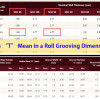
Technical Knowledge | What Does “T” Mean in a Roll Grooving Dimension Table?

What does “T” mean in a roll grooving dimension table? This article explains T as the minimum allowable pipe wall thickness and uses a 1" pipe example to show how it relates to SCH 5S, SCH 10, and SCH 40. It also explains why standard roll sets do not cover every wall thickness and when special roll sets may be required.

Sep 2,2026

Technical Knowledge | What Does “T” Mean in a Roll Grooving Dimension Table?

Operation Guide | How to Check Groove Diameter After Roll Grooving

Learn how to check groove diameter after roll grooving using a groove diameter tape or measuring tool. This guide explains why groove inspection matters, how to measure correctly, and what else to check before coupling installation.

Aug 17,2026

Operation Guide | How to Check Groove Diameter After Roll Grooving

Technical Knowledge | OGS vs. AGS Groove: Why Do Large-Diameter Pipes Need Advanced Groove Design?

This article explains the differences between OGS and AGS groove systems, why AGS is designed for large-diameter piping, and how groove design affects coupling performance and pipe connection reliability.

Aug 12,2026

Technical Knowledge | OGS vs. AGS Groove: Why Do Large-Diameter Pipes Need Advanced Groove Design?

Technical Knowledge | OGS vs. AGS Grooves: A Side-by-Side Comparison from Our Recent Grooving Test

OGS and AGS are two different grooved piping connection systems designed for different applications. Through a real grooving test, this article compares the differences between OGS and AGS groove profiles, explains why AGS is preferred for large-diameter piping, and shows how compatible roll grooving machines can switch between different groove systems by using dedicated roller sets.

Jul 27,2026

Technical Knowledge | OGS vs. AGS Grooves: A Side-by-Side Comparison from Our Recent Grooving Test

Selection Guide | Manual Hydraulic vs. Automatic Hydraulic Roll Grooving Machines: Which One Fits Your Project Better?

Hydraulic and automatic roll grooving machines are both used for steel pipe grooving, but they suit different working needs. Hydraulic machines are more flexible for job sites, installation work, and medium-volume processing, while automatic machines are better for workshops, batch production, and higher efficiency. This article compares their key differences and helps users choose the right machine based on pipe size, workload, working environment, and production needs.

Jun 15,2026

Selection Guide | Manual Hydraulic vs. Automatic Hydraulic Roll Grooving Machines: Which One Fits Your Project Better?

Selection Guide | How to Choose the Right Roll Grooving Machine for Your Pipe Size and Job Site

Choosing the right roll grooving machine depends on more than the maximum pipe size. Pipe diameter, wall thickness, material type, job site conditions, production volume, and application all affect the final selection. This article explains how to choose a suitable roll grooving machine for different projects, from small and medium-size pipe installation to large-diameter pipe grooving, workshop prefabrication, pipe fitting grooving, and high-accuracy groove cutting applications.

Jun 10,2026

Selection Guide | How to Choose the Right Roll Grooving Machine for Your Pipe Size and Job Site

Troubleshooting | Why Bell-Mouth Happens in Pipe Grooving and How to Reduce It

Bell-mouth is a common pipe-end deformation problem in roll grooving, especially on thin-wall or larger diameter pipes. This article explains why it happens, including pipe support, pressure control, roller matching, and pipe-end preparation, and shares practical ways to reduce deformation and improve groove consistency in daily steel pipe grooving work.

May 13,2026

Troubleshooting | Why Bell-Mouth Happens in Pipe Grooving and How to Reduce It

Technical Knowledge | Integrated vs. Split Hydraulic Systems: What Really Affects Maintenance and Oil Life?

Split hydraulic systems use a sealed pump design to prevent air and dust from entering the oil circuit, reducing contamination. Compared with traditional integrated systems, they can extend oil change intervals to 1–2 years, lower maintenance frequency, and improve long-term operating stability. The CM series applies this design consistently across different size models.

Apr 29,2026

Technical Knowledge | Integrated vs. Split Hydraulic Systems: What Really Affects Maintenance and Oil Life?

Technical Knowledge | Pipe Straps vs. Pipe Hangers: What’s the Difference?

Pipe straps and pipe hangers serve different support roles in piping systems. Straps are used for surface fixing in light-duty applications, offering simple and cost-effective installation. Hangers suspend pipes for heavier loads, providing greater flexibility and support. Choosing between them depends on load requirements, installation method, and application conditions.

Apr 27,2026

Technical Knowledge | Pipe Straps vs. Pipe Hangers: What’s the Difference?